QUÉBEC MEGA TRAIL HISTORY: FROM A 25K DEBUT TO CANADA'S BIGGEST ULTRA
The Québec Mega Trail began in 2012 as a single race of roughly 25 kilometers, built on the foundation of an earlier event called the Trans-Vallée. Jean Fortier, who founded the race and still directs it, had moved to Mont-Sainte-Anne near Beaupré that year and set out to design a course that road runners and trail runners could both enter. More than a decade later, the event has grown into the largest trail running gathering in Canada, with a four-day program of races and a flagship ultra that runs 135 kilometers through the Charlevoix region.
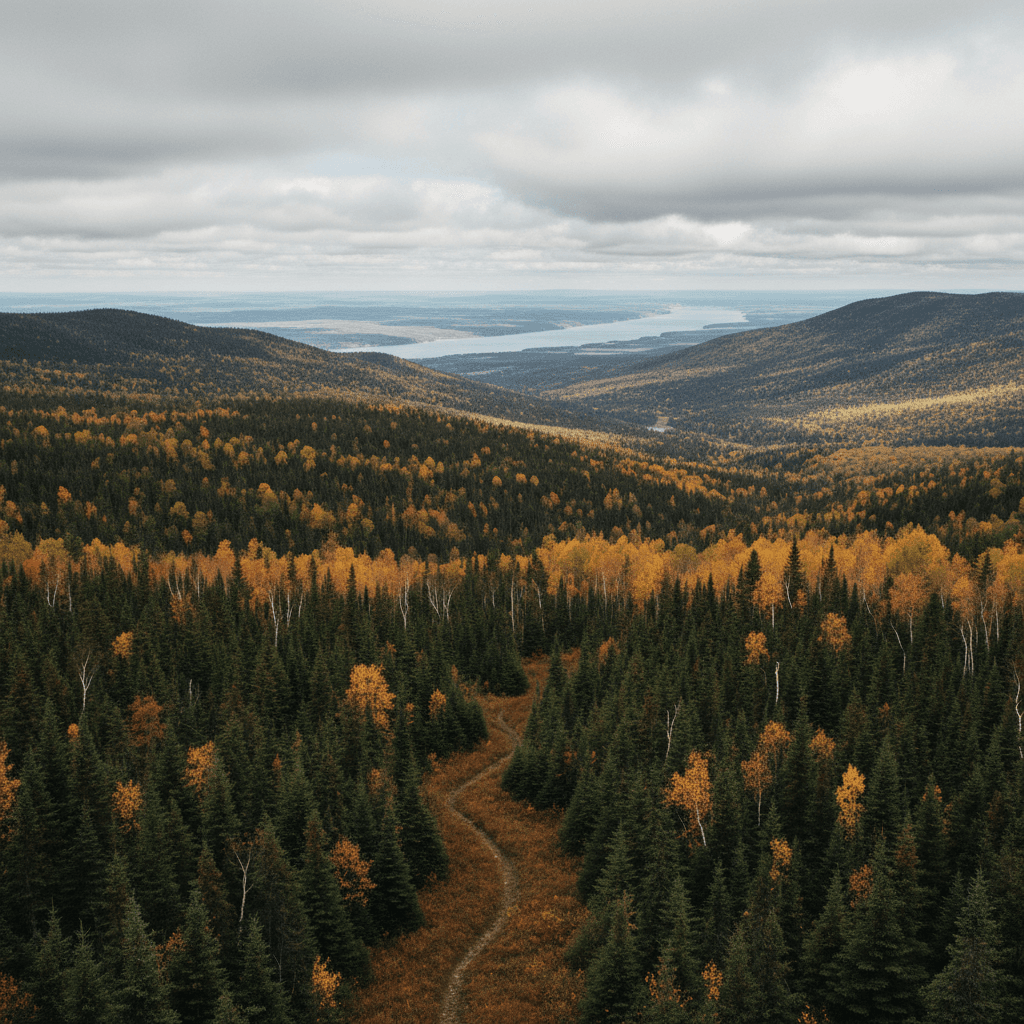
The race sits about 30 minutes northeast of Québec City, on a trail network that the organizers describe as the most used in the province. That setting has given the event a clear identity. It pairs a defined mountain, Mont-Sainte-Anne, with the maritime landscape of the St. Lawrence River, and it threads runners between open summits and enclosed forest valleys within a few kilometers of trail.
Terrain and Setting
The defining feature of the course is contrast. The region shifts from open, panoramic summits to wild, enclosed valleys over short distances, a quality that shows up in landmarks like the Sentier des Caps in Charlevoix and the Jean-Larose falls. The combination of vertical relief, water, and dense boreal forest is what Fortier points to when he describes Mont-Sainte-Anne as a playground for trail running. Few races, he has said, offer such a pronounced split between mountainous and maritime atmospheres.
The area also carries deep history that the race runs through rather than around. The Sainte-Anne-de-Beaupré Basilica is one of North America's most significant pilgrimage sites, and the surrounding territory was among the first settled in New France. Over time the Côte-de-Beaupré became a destination for skiing, mountain biking and trail running, and the event has positioned the region as the center of the sport in Canada.
A Festival of Distances
The Québec Mega Trail is not a single race but a stack of them held over one weekend. The 2026 program runs from July 2 to 5 and offers eight distances ranging from 6 to 135 kilometers, plus a one-kilometer race for children. That breadth is part of how the event reached its scale. A beginner can enter the 6K on the same weekend that an international field contests the 135.
The growth has been steady rather than sudden. The inaugural 25-kilometer course was designed to be accessible, and the event added longer and more technical races over the years as its reputation spread. By the time the 100-mile distance arrived, roughly in 2022, the race had already drawn accomplished trail runners from outside Canada.
The scale is now considerable. The 2024 edition brought together about 3,500 runners from 18 countries across all distances, and nearly 200 of them lined up for the 100-mile race alone. That mix of mass participation and elite competition is unusual for a North American trail event, and it is the core of what the Québec Mega Trail has become.
The event has kept its local roots through that growth. Volunteers and aid stations draw repeated praise from the runners who pass through, and the race remains tied to the community around Mont-Sainte-Anne even as the field has become international. Several of the athletes who feature at the front are from Quebec, and the race tends to reward runners who know the technical ground rather than only those with the fastest legs.
The QMT135
The flagship distance is the QMT135, a point-to-point race of about 134 kilometers with 6,000 meters of elevation gain, a format that invites comparison with Madeira's end-to-end island crossing at MIUT. It starts in the town of Baie-Saint-Paul and runs first along the St. Lawrence River before climbing into Le Sentier des Caps de Charlevoix. From there the course works toward the canyon of the Sainte-Anne River and the Mestachibo trail, reaches the Jean-Larose falls, and then climbs Mont-Sainte-Anne nearly twice before finishing at the foot of the mountain.
The difficulty is rated at the top of the scale. The race carries a technical level of five out of five, a cutoff of 37 hours, and an average finishing time near 26 hours. It awards five ITRA points and serves as a Western States 100 qualifier for runners who complete it in 32 hours or less. The qualifying standard to enter is itself demanding, requiring a prior ultra worth at least 75 points under the ITRA distance-and-climb formula.
The course record book for the QMT135 is short because the distance is new. The 135-kilometer race was introduced in 2025, and both inaugural marks still stand as the course records. On the men's side, Xavier St-Cyr of Canada won in 17:18:05, a result that surprised the field. St-Cyr, a medical resident, was not listed among the elites and described a difficult start before moving to the front and holding the lead from kilometer 66 onward. Matthieu Saliou finished second in 17:43:32, and France's Sébastien Camus took third in 19:00:02.
The women's race that day went to Maryline Nakache of France, who won in 19:11:41 and placed fourth overall across all genders. Canada's Geneviève Nadeau led the race through the morning before finishing second in 20:26:04, and Mylène Sansoucy completed the podium in 20:33:31. The day was hot rather than the cool weather that had been forecast, and course records also fell in the 80-kilometer, 50-kilometer, and 32-kilometer races.
The 100-Mile Race and Its Records
Before the 135 became the headline distance, the 100-mile race carried much of the event's elite weight. Sangé Sherpa, a Nepalese runner based in France, set the early standard with a sub-20-hour finish of 19:35 in 2022.
That mark held until 2024, when Quebec's Jean-François Cauchon broke it. Cauchon had unfinished business at the race. He had finished second in 2022, then led for much of the first half in 2023 before stomach trouble forced him out at 124 kilometers. In 2024 he ran 19:01:25 to take the win and the course record, with Ferdinand-Clovis Airault second in 19:32:02 and Sherpa third. A civil engineer who trains on the same trails, Cauchon has described the race as being in his backyard.
The women's 100-mile race in 2024 produced its own record. Anne Champagne won the distance and set a new women's course record, leading a field that included Kelsey Hogan and Mélina Dubois-Verret on the podium.
The Only Canadian World Trail Major
The Québec Mega Trail is the only Canadian event in the World Trail Majors, a global series that links established ultra races across Asia, Europe, Africa and North America alongside stops such as England's South Downs Way 100. Membership in that circuit placed the race alongside long-running international events and drew a wider elite field to Mont-Sainte-Anne.
The race has also hosted national competition. The Canadian Trail Running Championships have been contested within the event, which sharpened the depth of the domestic fields in the 80-kilometer and 50-kilometer races and brought American and other international runners into direct contention with the Canadian title chase.
That overlap produced close racing in 2025. American Eric LiPuma won the 80-kilometer race outright, which left Jean-Philippe Thibodeau to claim the Canadian title just behind him. In the women's 80-kilometer race, Claudine Soucie took the national gold while holding off American Britta Clark. The 50-kilometer race saw Élisa Morin finish second overall regardless of gender and break the women's course record, while Dany Racine won the men's race in a course-record time. Having a national championship folded into the festival weekend gave those mid-distance races a competitive edge that a standalone event would struggle to match.
A Step Onto the World Stage
The next stage of the race's growth arrives in 2026, when the Québec Mega Trail joins the Golden Trail World Series. The event is the first of three new venues added to the series for that season and marks the first time the circuit has raced on Canadian soil. The series stop is scheduled for July 5 as part of the larger festival weekend.
To fit the Golden Trail format, which favors shorter and faster mountain courses than the 135, the event built a new 30-kilometer course for 2026. It carries 1,450 meters of elevation gain and runs around Mont-Sainte-Anne, opening with a double climb and descent before dropping down the mountain's northern face into forest. Fortier has said the course rewards runners who can climb well, descend on technical ground, and open the pace where the terrain allows.
The move reflects the trajectory the race has followed since its first 25-kilometer edition. It started as a local race designed to be approachable, grew into Canada's largest trail event, added the longest and most difficult distances in the country, and then attached itself to two of the sport's international series. Fortier has framed the Golden Trail invitation as a natural fit for an event he has always wanted rooted in its territory while reaching for a wider stage.